
Don’t Stop
One of these whatever-they-are that resonated was the one about objective truth (I like to keep the topics light-hearted around here). For example, Brian wrote back to agree that Ed Cooley absolutely should have been canned for beaning a kid with a water bottle (and if you haven’t watched the apology video, you need to…though perhaps he redeemed himself by signing a new highly-regarded point guard).
Then Brendan wrote to tell me that this topic was one they were recently discussing in his Plato study group.
“Wait, what?” I said. “You have a Plato study group?”
He said yes – because it was a topic worth studying.
I agreed and was jealous. In fact, I took an entire semester-long class in college on The Republic and loved it. (I did the same on Doctor Zhivago…a college hack is that if you take a class that deep-dives on one book, the reading load is much more manageable!)
And Steven made the point that time is the most important part of any of this. Because the longer the timeline, the more likely it becomes that merit will carry the day. So “the most important thing,” he concluded, “is not to stop.”
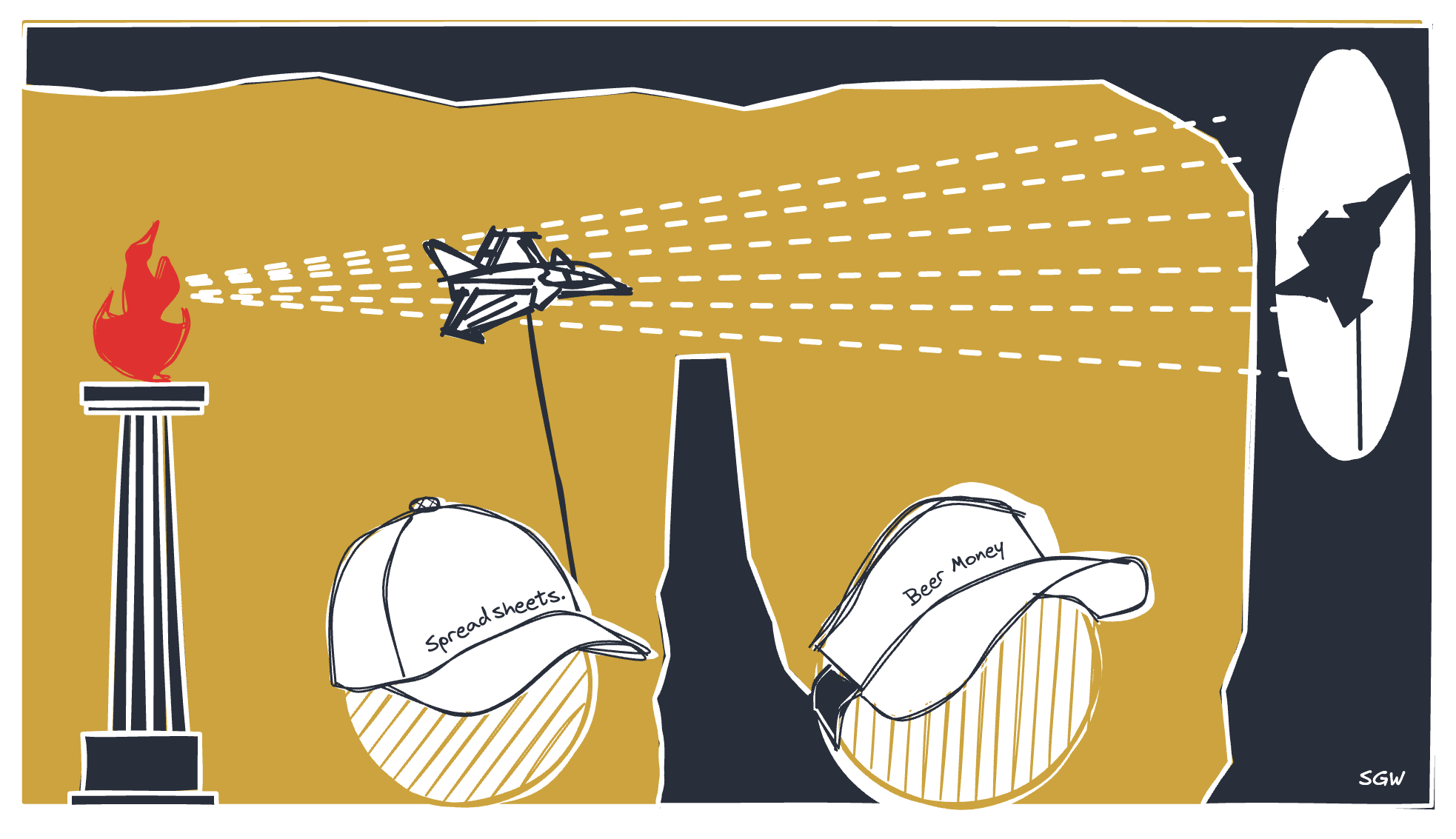
That hit home with me because I had recently been invited to speak at one of our portcos’ quarterly all-hands and was asked how we were thinking about and preparing for all of the economic disruption that might arise from higher oil prices, blockaded straits, and the potential annihilation of entire civilizations.
Not to be glib, but I pointed to that paper that measured the last 500-plus years of returns and noted that if your time horizon is long enough, returns tend to take care of themselves even if outcomes are never guaranteed. So when faced with the prospect of economic dislocation, the key is not to try to predict what will happen next, but to make sure you are positioned to withstand the consequences of whatever it is that happens.
I wrote a while back that you can only lose a game that ends, and I continue to think that’s the right way to think about things.
– Tim
Sign up below to get Unqualified Opinions in your inbox.
The information, opinions, and views presented in this publication are provided solely for general informational and educational purposes. They are of a general nature, have not been tailored to the specific circumstances of any individual or entity, and do not constitute a comprehensive statement of the matters discussed. This material should not be interpreted or relied upon as investment, legal, tax, accounting, regulatory, or other professional advice, and nothing in this publication is intended to be or should be construed as such. You should obtain advice from your own professional advisors regarding the applicability of the information to your particular circumstances.
The views and analyses expressed are those of the author and do not necessarily represent or reflect the views, opinions, policies, or positions of Permanent Equity Management, LLC, its officers, directors, employees, affiliates, or portfolio companies, or of any person or entity with whom the author may be affiliated. Permanent Equity Management, LLC makes no representation or warranty, express or implied, as to the accuracy, completeness, timeliness, or suitability of the information contained herein and expressly disclaims any liability for errors or omissions.
This publication is not, and should not be construed as, an offer to sell, a solicitation of an offer to buy, or a recommendation of any security, financial instrument, or other product. It does not form the basis of any contract and does not create a fiduciary, advisory, or client relationship with Permanent Equity Management, LLC. Any examples or references to third-party content are for illustrative purposes only and do not constitute an endorsement. Permanent Equity Management, LLC is not responsible for the availability, accuracy, or content of third-party materials. Past performance is not indicative of future results. Any forward-looking statements are inherently uncertain and subject to change.