
Taylor’s Bruce Springsteen Syllabus
A few weeks ago I was having a discussion and the topic of last year’s Bruce Springsteen biopic Springsteen: Deliver Me From Nowhere came up (Side note: The book that served as the inspiration for that film was one of my favorite music-related reads of all-time. It is all about the making of Springsteen’s seminal record Nebraska, which, if you do not know the story behind it, you should read it. Imagine, you score your first top ten single [“Hungry Heart”] and first No. 1 album [The River], then follow it up with an acoustic record you recorded alone in your bedroom. You do not promote it. You do not put your face on the cover. You do not tour behind it. You just put it out into the world).
As excited as I was to talk about the film, the conversation eventually produced a question to me that I have spent the better part of my adult life preparing to answer: “If I want to get hooked on Springsteen, where should I start listening?” And thus, my Bruce Springsteen syllabus was born. [Editorial note: the double spaces behind periods are Taylor’s. They’re intentional, and he triple-spaces in text messages to make sure they’re there too.]
The first record that got me hooked was Nebraska (see above), but I would not start there.
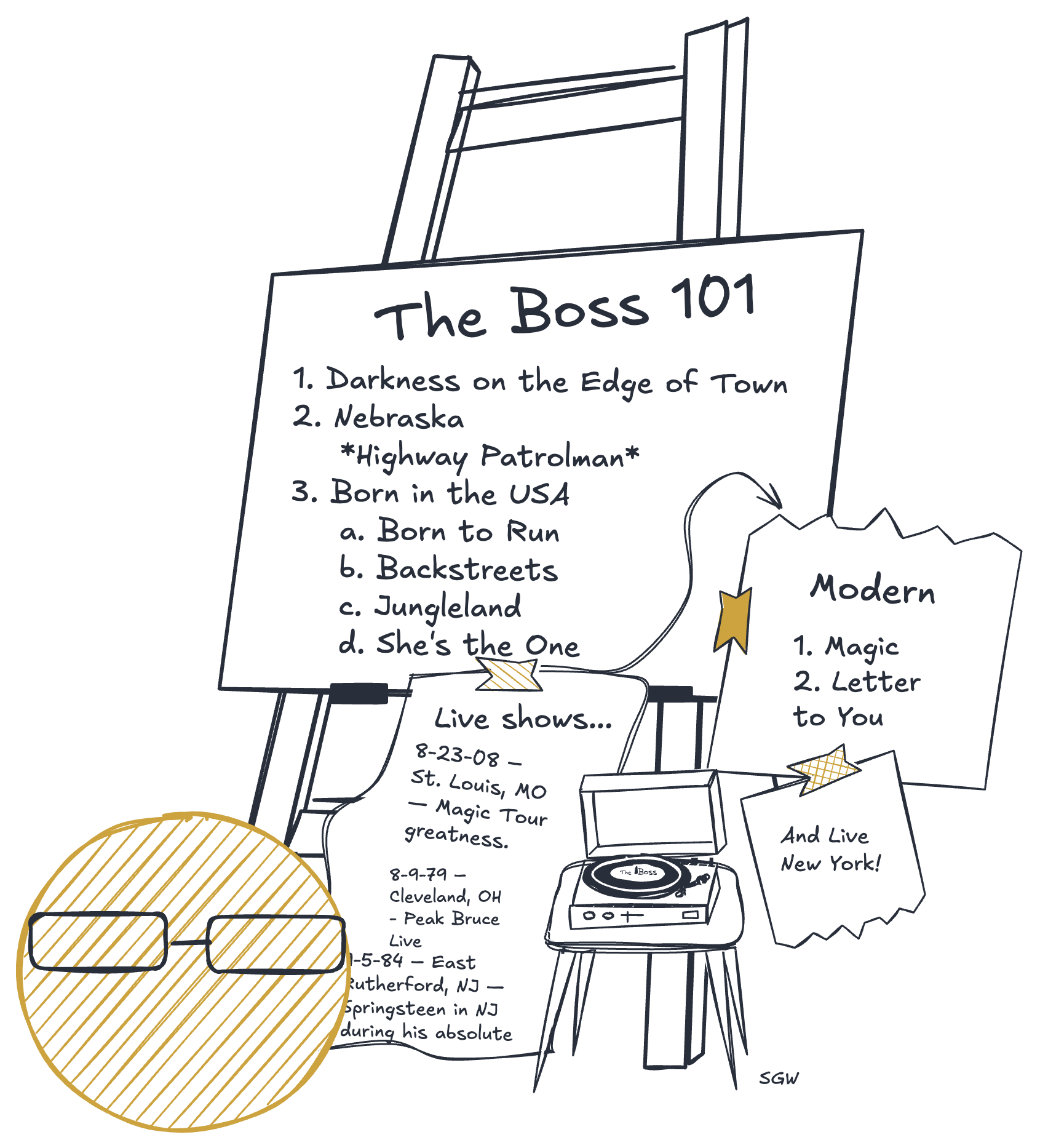
In order to really begin to understand the trajectory of Springsteen’s songwriting and his career, you have to start with Born to Run. It is not my #1, but as his first commercially successful album, the one that gave him his break, the one that landed him on the cover of Time and Newsweek in the same week, this is the foundation, this is where Bruce’s writing changed, becoming more concise and focused. The stories and the characters are as big as the music. They are young, restless, convinced that there is a better life for them further down the road…anywhere but here. And the music sounds just like that. Almost everything that comes later, starts with this record. Everyone knows the title track, but “Backstreets” and “Jungleland” (Clarence “Big Man” Clemons’ sax solo near the end is on another level) are where it is really at. And the sleeper pick is “She’s the One.”
From there, you have to listen to Darkness on the Edge of Town. My favorite record top to bottom. End of story. Born to Run is incredible, but this is the record for me. The story behind it, the context, it is all amazing. Imagine if the guy from Born to Run, the guy who was ready to get out of town and chase his dreams, found out that sometimes life does not work out. Sometimes you leave and still end up carrying the same things with you. Born to Run is about getting out. Darkness is about what happens when you realize there really is no getting out. You just have to figure out what kind of person you are going to be. You can hear the loss of innocence. Mix all of that with Bruce beginning to work through his complicated relationship with his father, and you get one of my favorite tracks on the record, “Adam Raised a Cain.” Then there is “Racing in the Street,” where Roy Bittan’s piano provides the score for the story of two weary lovers trying to find a way to start over as they “ride to the sea and wash these sins off our hands.”
Skip forward a bit and hit Nebraska as it really starts the run towards Born in the USA, but is singular in its sound and feeling. Never heard a major label record quite like it. It is sparse, barren, and bleak. Just Bruce, his guitar and harmonica. The perfect kind of music for the type of people he was writing about on this album: criminals, drifters, people on the margins. Bruce has been pretty clear about how much this record was influenced by the Southern Gothic stories of Flannery O'Connor and films like Terrence Malick’s Badlands. One listen and you can hear those influences all over it. “Highway Patrolman” is my favorite song on this record. Incredible storytelling, and Sean Penn made a movie based on just this one song.
Of his more modern work, I would hit three different records:
First is Magic. Released in 2007, I think this is Bruce’s most underrated record of all time. This album finds Bruce and the E Street Band bringing back the big sound and energy of their earlier work. Honestly, this might be the closest he and the band ever got to the big sound of Born to Run and The River (double album released after Darkness) in the latter part of their career. Standouts are “Radio Nowhere,” “Gypsy Biker,” and “Devil’s Arcade,” Also, don’t overlook “Long Walk Home.”
Second is The Rising. Is this his best music? No (I mean, it’s still great). But the context here makes all the difference. This record was released in the shadow of 9/11 with Bruce trying to make sense of what happened through the lives of people who lived through it. Ordinary people dealing with loss, grief, fear and clinging to faith. Fans point to the title track, but my favorites are “My City of Ruins” and “Empty Sky.” Second side note, do yourself a favor and try to find the video of Eddie Vedder performing “My City of Ruins” at the Kennedy Center Awards in 2009.
Finally, Letter to You. If Born to Run was a record about youthful desires to run and escape, this record is a fitting bookend, with Bruce now looking backward. Thinking about his own mortality, his friends, the people he has lost and the journey he has made. “Letter to You,” “Burnin’ Train,” “Ghosts,” and “Janey Needs a Shooter” are some of my favorites.
Also, you HAVE to listen to Live in New York City. One of the greatest live records of all time. It was recorded live during a 10-night stand at Madison Square Garden following the reunion of Bruce and the E Street Band following a nearly 10 year hiatus.
While we are on the topic, you really cannot understand Bruce without getting into the live stuff. The studio records are obviously the foundation, but his reputation was built on stage. Bruce and the E Street Band became legendary because these were not normal shows. They were three-hour-plus religious experiences: constantly changing setlists, incredible energy, and Bruce leaving everything he had on stage. He would often end the night drenched in sweat and physically exhausted. There are songs that I like on the records that I absolutely love live because they become something different.
I have collected a bunch of shows over the years, and if you want to get into that side of Bruce, these are some of my favorites:
8-23-2008 – St. Louis, MO – Magic Tour greatness. One of the first shows I went to and still a favorite. Bruce and the band played for more than four hours, including an incredible cover of The Crystals’ “Then He Kissed Me,” refashioned as “Then She Kissed Me,” which Bruce had not played live since their famous 5-day stand at the Bottom Line in New York City in 1975.
8-9-1978 – Cleveland, OH -–Peak Bruce Live. The extended versions of “Backstreets,” “Prove it All Night,” and “Because the Night” are amazing. People forget/don't know that Bruce can wail on the guitar and this shows him at his best. The 1978-1979 Darkness tour might be the best run for Bruce and the Band…ever. Listen to EVERY SHOW YOU CAN.
9-5-1984 – East Rutherford, NJ – Springsteen in New Jersey at the absolute peak of his fame following the release of Born in the U.S.A. This is Bruce having gone from rock star to one of the biggest musicians in the world almost overnight.
11-7-2009 – New York, NY – In the middle of the show, Bruce plays his second record, The Wild, the Innocent & the E Street Shuffle in its entirety, front to back. That alone makes this one worth hearing. “Incident on 57th Street” is the standout here for me.
12-29-80 – Uniondale, NY – Great show during The River tour. Plays something like 35 songs in a massive set.
Also, don’t sleep on his first two records Greetings from Asbury Park and The Wild, the Innocent and the E Street Shuffle. Both different from the Bruce we know now, but great.
The TLDR (and you probably need this when you ask a Springsteen guy to start talking about The Boss) is this: start with Born to Run and Darkness on the Edge of Town. Those two records give you the foundation. From there, jump to Nebraska, then explore the later records, and somewhere along the way start listening to the live shows. Because the records tell you why the songs matter, but the live stuff explains why Bruce became Bruce.
Or, just let a song catch you. The rest finds you on its own. (When it does, hit me up. I will clear the afternoon.)
If you want more, Professor Taylor is in session. Listen in to his 12-minute lecture on Bruce’s progression from the early records to Born to Run to The Darkness on the Edge of Town. It’s an off-the-cuff tour de force.

Sign up below to get Unqualified Opinions in your inbox.
The information, opinions, and views presented in this publication are provided solely for general informational and educational purposes. They are of a general nature, have not been tailored to the specific circumstances of any individual or entity, and do not constitute a comprehensive statement of the matters discussed. This material should not be interpreted or relied upon as investment, legal, tax, accounting, regulatory, or other professional advice, and nothing in this publication is intended to be or should be construed as such. You should obtain advice from your own professional advisors regarding the applicability of the information to your particular circumstances.
The views and analyses expressed are those of the author and do not necessarily represent or reflect the views, opinions, policies, or positions of Permanent Equity Management, LLC, its officers, directors, employees, affiliates, or portfolio companies, or of any person or entity with whom the author may be affiliated. Permanent Equity Management, LLC makes no representation or warranty, express or implied, as to the accuracy, completeness, timeliness, or suitability of the information contained herein and expressly disclaims any liability for errors or omissions.
This publication is not, and should not be construed as, an offer to sell, a solicitation of an offer to buy, or a recommendation of any security, financial instrument, or other product. It does not form the basis of any contract and does not create a fiduciary, advisory, or client relationship with Permanent Equity Management, LLC. Any examples or references to third-party content are for illustrative purposes only and do not constitute an endorsement. Permanent Equity Management, LLC is not responsible for the availability, accuracy, or content of third-party materials. Past performance is not indicative of future results. Any forward-looking statements are inherently uncertain and subject to change.