
All the F-Bombs
Contents
These insights were adapted from Permanent Equity CIO Tim Hanson’s newsletter, Unqualified Opinions. You can find more and sign up at https://www.permanentequity.com/newsletters.

Download the PDF
I’m Effin’ Rich
The F-bomb corollary strikes again.
One of the questions we ask business owners when we meet them is "What keeps you up at night?" The point of this question is mostly to suss out what mitigatable risks in the business haven't been mitigated yet. And while typical answers are about a key supplier or employee, the most surprising answer came on a recent site visit when a gentleman who had plenty of risks that might keep him up at night said simply, "Nothing. I'm [effin'] rich."
I’ve got a rule for Unqualified Opinions: if you drop an f-bomb in casual conversation with a Permanent Equity team member, there is a 100% chance you are going to get written about — and doubly so if that team member happens to be me. So, I keep track. And it turns out that people drop the f-bomb in all sorts of interesting ways. Hence, this collection.
For now, back to the gentleman.
Reactions to the idea that nothing kept this person up at night because he was effing rich proved divisive. The reason that's so is because of how one views capital. It could be an outcome or opportunity, a reward or a responsibility… And also a chance to blow it all…
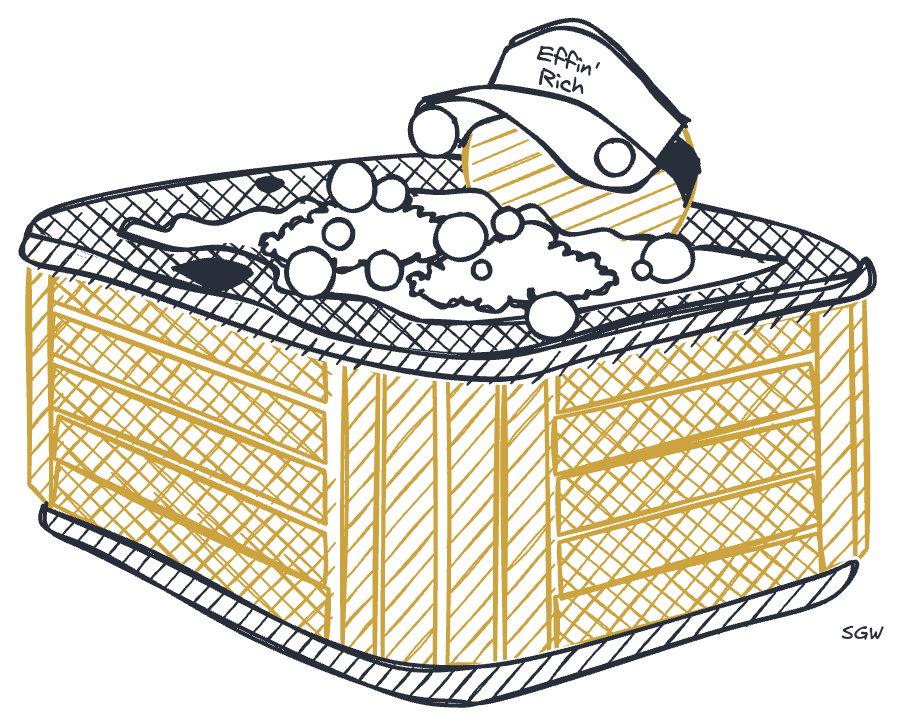
One reaction, of course, was admiration. This was a person who at this point in his life was seemingly playing with house money. He had his family, the car and house he wanted, and a hot tub and a minifridge to come home to. If happiness is reality minus expectations, then he was living the dream…and had every right to.
Another, though, was frustration. With means, why settle? A hot tub and a minifridge is certainly something, but it's not everything.
The third, however, was skepticism. Because if you're not vigilant about how fast circumstances can turn, well, circumstances will turn.
Anyway, it was a solid meeting, but they ended up going with a different partner. All good; it happens. And the guy pocketed a lot more money. So now he's effin' richer. I wonder if anything keeps him up at night now?
Are We Effed?
Brent thinks so.
Brent (our founder) recently sent me a Twitter thread from someone who declared that we are effed. He knew a software developer in Pakistan who used ChatGPT 4 to study a hundred thousand Shopify sellers and then email three thousand of them each a plan for a unique custom app that it ideated that the software firm might build for them to improve their business. It was a massive, audacious cold email campaign and apparently it worked. The response rate was off the charts and in order to handle the volume, he also had ChatGPT 4 respond to the responses.
Minds were blown… The AI learned about the target company, learned about the capabilities of the software firm, brainstormed reasonably good ideas at scale, and then credibly interacted with other humans on specific topics.
After he sent me the thread Brent wanted to know (1) how we might employ similar capabilities to benefit our business and (2) what the endgame of widespread adoption of this technology might be.
With regards to (1) the answer is really any detail-oriented, repetitive task. For example, ChatGPT could be trained to look at company financials, identify red flags, and engage in initial due diligence over email, handling both initial questions and follow-ups, particularly if you helped it figure out what to look for. Now, you probably wouldn’t want it doing these things unsupervised, but if it could get you 90% of the way there, that would result in a significant efficiency level up.
Which brings us to (2)…
If you work online, you are about to get flooded with AI-generated solicitations. In fact, you probably already are (and Elon Musk already admitted as such). In fact, I kinda sorta suspect based on the tone that the original Twitter thread Brent sent me was generated by AI as well (and how meta is that?).
Being online is already a terrible place to be. Studies show that it’s bad for mental health and that it’s contributing to polarization. Moreover, my own experience is that the signal to noise ratio is deteriorating.
So what’s it going to be like when infinite bots are generating infinite content?
This is the dystopian turn our conversation took, but it ended on an optimistic note. In this world that may be nigh, the value of two very human qualities should skyrocket: judgment and authenticity. Judgment because in a world of infinite content it is going to be very valuable to be able to differentiate the good from the bad and the high potential from the low. Authenticity because in a world of infinite content the only content that anyone will respond to will be words that really resonate.
What’s more, are we going to become cynical and skeptical about who we think we’re interacting with? If you think it’s a bot on the other side, how likely might you be to engage? If very, what are you going to do?
We thought about that and wondered if it might drive people to deepen human, in-person relationships. You’ll reach out to the people you know and want to talk with them directly. Workers are already returning to the office in droves following a few years of unsatisfying remote work that many initially thought would be a boon for productivity and finding that they like it. It turns out we’re social creatures.
So whatever else happens with AI, if it puts us back in real world contact with one another, that would be a real benefit. And an improvement. And perhaps help us not be effed. Because judgment and authenticity matter.
P.S. This was written by ChatGPT 4.
P.P.S. Just kidding…but how might you tell?
You Effing Guys
What is means to be different.
Danny and his great head of hair walked into my office with a smile on his face the other day so I asked what was up? (Not that Danny is normally dour or anything. Rather, it was clear that something entertaining had just happened.)
“I was on the phone with someone I met at DealMAX, and it was the strangest conversation. He started off by asking what the [eff] we do and after I told him we buy businesses using 30 year funds with no debt, all he said was ‘The [eff]?’”
Of course, that prompt made me perk up because if you’re dropping f-bombs in casual conversation with a member of the Permanent Equity team there is a 100% chance you are going to get written about in this space.
While that was an awkward start to Danny’s call, it got better from there because it turns out that this guy had had in his estimation more than 7,000 conversations with private equity firms over the course of his career. He said that he’d always make sure to ask what made the firm he was talking to different from all of the other firms and why someone would sell them something instead of to the other guy for any reason other than “more money.”
“And you [effing] guys,” the guy told Danny, “are the first ones I’ve ever talked to whose answer actually makes you different.”
That’s what made Danny smile, and it made me smile, too. Because it’s one thing to tell people you’re different, but another thing entirely when people tell you you are.

Generational F-Word Wealth
How not to get it.
My daughter and I were driving home from town on I-70 at night recently when we came up behind a state trooper. Seeing him from a ways back, I dutifully pulled into the right lane and set my cruise control at the speed limit.
Not long after a car passed me on the left at a pretty good rate of speed. It startled me, though, because it didn’t have its headlights on. Then, as it passed, I noticed that it also didn’t have license plates.
“Well, this should be interesting,” I said to my daughter.
“What do you mean?” she asked.
“That guy is about to blow by a cop, without his headlights on, and with no license plates.”
You can probably figure out what happened next.
And this happened on the same day that our CEO Brent had forwarded me a voicemail he had received from someone calling himself the “Hole-Poker” who was an “oil man” and a “very serious person.” The Hole-Poker was asking for “10, 20, or 200 thousand dollars” of capital to bring a project home and create “generational [f-word] wealth.”
Further, he promised that if one invested in his opportunity one would have their money back “within the week,” their kids’ college paid for “within the month”, and after a year, have created “generational [f-word] wealth.”
This, you probably don’t need to be told, is securities fraud.
I recount these anecdotes here to point out that while the actions of these two individuals seemed somehow advantageous to them at one time, rarely does brazen flaunting of the law work out well for anyone. Moreover, lest that seem like an obvious point, here are two individuals doing just that, in my small corner of the world, within hours of each other on the same day. You have to wonder what other ridiculous things went on in the world that day.
So as you head into the weekend, if you’re presented with the opportunity to do something brazenly illegal, don’t. It’s poor risk management and certainly not the way to create generational f-word wealth. I wish no one had to be told that, but at the risk of making another obvious point, here we are.Have a great one.

Midwest BS
I hit a nerve.
Someone from one of the coasts called me out recently for my “midwest bullshit.” This made me chuckle, since I’m from New York. But now there’s a corollary to the f-bomb axiom: allegations of “midwest bullshit” will also get you written about. Because who doesn’t love unexpected profanity?
The backstory is that this person was unhappy that something we discovered during diligence on a deal caused us to ask for more risk-mitigating structure than was in our LOI. Their view was that we were retrading. Ours was that we had new information. I won’t bore you with the details, but being from the Midwest (even if I’m a New Yorker by birth) doesn’t make anyone at Permanent Equity a pushover.
Something I’m catching onto as I see more and more things in life and work is that the strongest points of friction pop up when you really hit a nerve. In other words, the other side kicks back hardest when you maybe point out something they deep down know is true, but hope stays hidden, particularly when they have an informational advantage. Otherwise, people are mostly reasonable.
So if you hit a nerve and experience the kickback, walk. It probably means you’re onto something that can’t be papered over. And if that’s “midwest bullshit,” no wonder I moved here. I’m glad I did.

Space Junk
Are you effing kidding me?
One of the craziest stories I’ve been following recently awaiting resolution was that of the Florida man whose house got bombed by NASA. Because way back in March 2021 the International Space Station decided to throw out 5,800 pounds of old batteries, expecting them to burn up in Earth’s atmosphere and disappear forever. But 1.6 pounds sneaked through, blowing a hole in Alejandro Otero’s roof in March 2024 and crashing through two floors while almost decapitating his son.
Whoops.
Commenting on the fact that the rocket scientists didn’t quite get the math right on this one, NASA wrote:
The International Space Station will perform a detailed investigation of the jettison and re-entry analysis to determine the cause of the debris survival and to update modeling and analysis, as needed. NASA specialists use engineering models to estimate how objects heat up and break apart during atmospheric re-entry. These models require detailed input parameters and are regularly updated when debris is found to have survived atmospheric re-entry to the ground.
NASA remains committed to responsibly operating in low Earth orbit, and mitigating as much risk as possible to protect people of Earth when space hardware must be released.
Comforting, no?
I wrote a while back about the spreadsheet that presumably exists somewhere where if you change the value of one cell (the one that calculates estimated future viewing patterns of Netflix content and therefore the rate at which the cost of that content is amortized), you could double Netflix’s profit or cut it in half. Well, apparently there’s also a spreadsheet somewhere where if you change the value of one cell (the one that calculates how much various metals heat up and break apart during re-entry), it might get us all annihilated by falling space debris.
All things considered, Mr. Otero seems to have dealt with this manifestation of what I call “Are you effing kidding me?!” risk in a remarkably calm manner. He’s waited for NASA to confirm its findings and is asking them to “resolve the damages” (though I have no idea what court has jurisdiction over space releases and/or whether or not anyone could prove that NASA was negligent here). But if they don’t “resolve the damages,” well, are you effing kidding me?
Here are the takeaways:
Risky actions can take a long time to materialize into tangible consequences. While federal law may have a 5-year statute of limitations, the real world can punish you whenever it wants, so reserve accordingly.
Exogenous factors outside of our control are conspiring against us all the time, even up in low Earth orbit. You may not have time to worry about space junk, but you need to be prepared for space junk.
Oh, and your model is probably wrong.

We Can’t All Be MOFOs
When culture is shared.
We recently started doing some work with the law firm Morrison Foerster, and I was delighted to discover that the good people who work there refer to themselves as MoFos (and I bet you wouldn’t have guessed than a prestigious international law firm was the denizen of mofo.com…but be careful not to add an ‘s’ to that – whoops).
Anyway, when the MoFos we are working with realized that fact so delighted us, they sent us a bunch of MoFo swag. Now our CLO Taylor (who originated the relationship) and the rest of us (but mostly Taylor) fight about who gets to drink coffee out of the MoFo mug.
Semi-related, if I have a nit with our name Permanent Equity, it’s this: it doesn’t easily lend itself to a clever demonym like MoFos. The best I’ve been able to come up with is PEër, (which despite having a clever connection to “peers,” sounds less like a colleague and more like a bodily function) and Permequian (which sounds too much like someone Arthur Dent would have met hitchhiking across the galaxy). And while there were all sorts of issues when we called ourselves adventur.es (throwback alert), I did like the potential of referring to ourselves as “Adventurers,” though maybe that’s corny.
I’ve written previously that culture is shared. Specifically, shared language, shared experiences, and shared standards. And what that all comes together to create is shared identity, which is a really hard thing to pull off. So if you have that, it would be nice to be able to put a name to it.
But we can’t all be MoFos.

The information, opinions, and views presented in this publication are provided solely for general informational and educational purposes. This publication is not, and should not be construed as, an offer to sell, a solicitation of an offer to buy, or a recommendation of any security, financial instrument, or other product. It does not form the basis of any contract and does not create a fiduciary, advisory, or client relationship with Permanent Equity Management, LLC.
The information, opinions, and views presented in this publication are provided solely for general informational and educational purposes. They are of a general nature, have not been tailored to the specific circumstances of any individual or entity, and do not constitute a comprehensive statement of the matters discussed. This material should not be interpreted or relied upon as investment, legal, tax, accounting, regulatory, or other professional advice, and nothing in this publication is intended to be or should be construed as such. You should obtain advice from your own professional advisors regarding the applicability of the information to your particular circumstances.
The views and analyses expressed are those of the author and do not necessarily represent or reflect the views, opinions, policies, or positions of Permanent Equity Management, LLC, its officers, directors, employees, affiliates, or portfolio companies, or of any person or entity with whom the author may be affiliated. Permanent Equity Management, LLC makes no representation or warranty, express or implied, as to the accuracy, completeness, timeliness, or suitability of the information contained herein and expressly disclaims any liability for errors or omissions.
This publication is not, and should not be construed as, an offer to sell, a solicitation of an offer to buy, or a recommendation of any security, financial instrument, or other product. It does not form the basis of any contract and does not create a fiduciary, advisory, or client relationship with Permanent Equity Management, LLC. Any examples or references to third-party content are for illustrative purposes only and do not constitute an endorsement. Permanent Equity Management, LLC is not responsible for the availability, accuracy, or content of third-party materials. Past performance is not indicative of future results. Any forward-looking statements are inherently uncertain and subject to change.