
It Has to Work
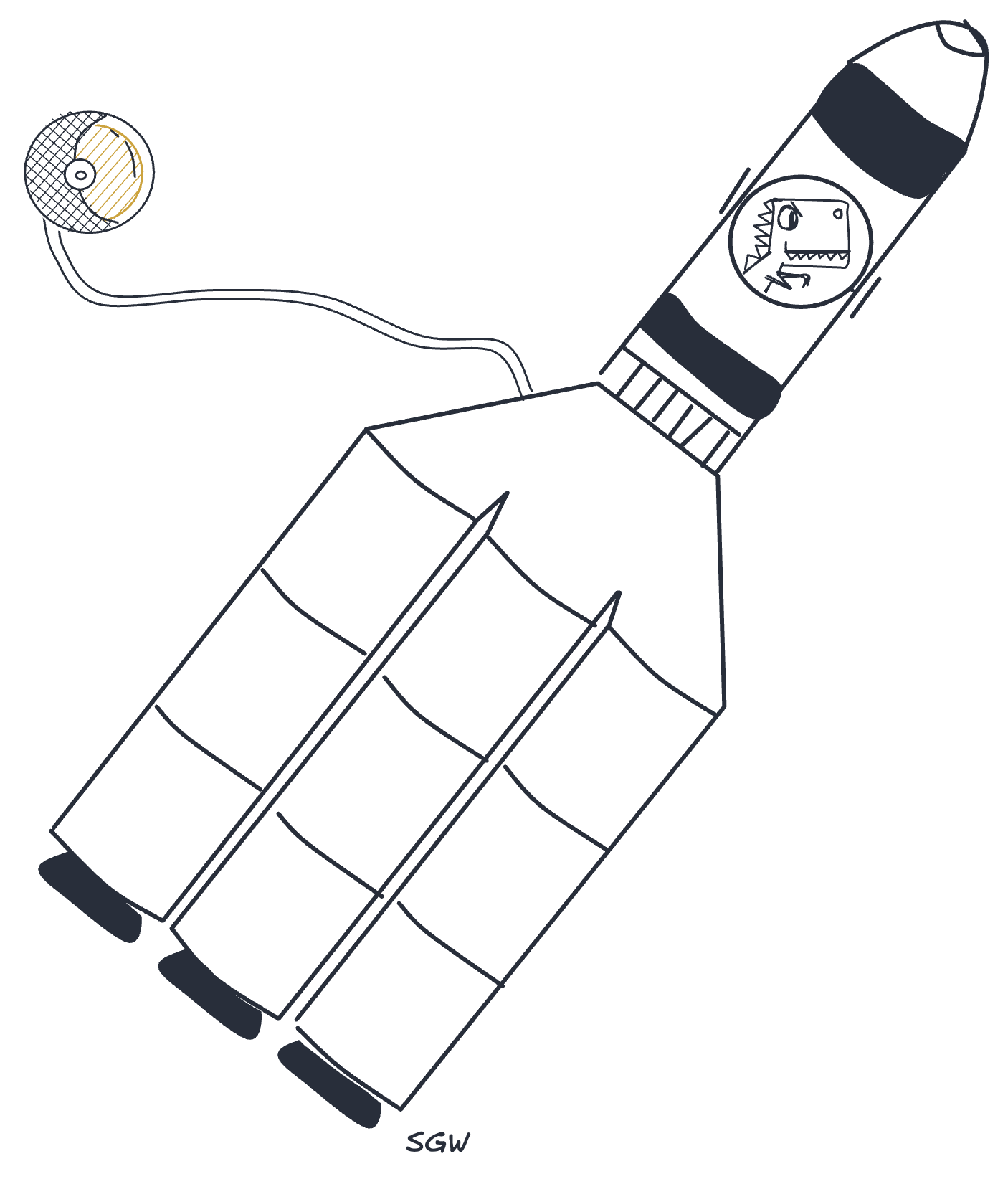
One of the books I read over spring break – because my wife recommended it – was Project Hail Mary (now apparently also an excellent movie starring one of Holly’s favorite actors, Ryan Gosling, who is definitely not Ryan Reynolds).
If you haven’t read it, the plot (no spoilers) is that a guy wakes up alone in outer space, light years away from Earth, with amnesia and realizes as his memories return that he’s there to save the world from an alien parasite that is sucking energy out of the sun. It’s sort of a physics/biology textbook meets sci-fi thriller meets Memento with some (potential spoiler alert) Jurassic Park Ian Malcolm vibes at the end, and it’s not bad.
As more and more memories come back, you learn how he ended up in that position, including how such an advanced spacecraft was designed and built. One of the things that struck me as that process was described is that there is intentionally no AI onboard – only well-worn algorithmic software. It’s explained that the reason for that is that if you find yourself alone in space, light years from Earth, the most important thing to have isn’t necessarily the most advanced technology, but the most reliable technology that works. Neural networks, the book suggests, are too unpredictable to be trusted given the high stakes.
I thought about that as I read a white paper Emily drafted and circulated internally about how the widespread adoption of AI might impact different kinds of business models. After all, people are still trying to figure out if AI might displace, augment, redistribute, or amplify people and products and on what timeline. But what I said to Emily is that for smaller businesses, the types we work with, it might be the case – at least for now – that the right answer is the Project Hail Mary approach: stick with well-worn algorithmic software.
That’s because at small businesses the team might be thin, the balance sheet might not have much ballast, and there might be supplier or customer concentration. So if a critical tool behaves unreliably and that unreliability leads to disruption, the disruption could snowball into catastrophe.
This, I know, runs counter to the more widespread view that AI technology will help small businesses save costs, generate revenue, and scale faster. But I’m torn.
That’s because small business isn’t saving the world, of course, but it’s still high stakes stuff.
– Tim
Sign up below to get Unqualified Opinions in your inbox.
The information, opinions, and views presented in this publication are provided solely for general informational and educational purposes. They are of a general nature, have not been tailored to the specific circumstances of any individual or entity, and do not constitute a comprehensive statement of the matters discussed. This material should not be interpreted or relied upon as investment, legal, tax, accounting, regulatory, or other professional advice, and nothing in this publication is intended to be or should be construed as such. You should obtain advice from your own professional advisors regarding the applicability of the information to your particular circumstances.
The views and analyses expressed are those of the author and do not necessarily represent or reflect the views, opinions, policies, or positions of Permanent Equity Management, LLC, its officers, directors, employees, affiliates, or portfolio companies, or of any person or entity with whom the author may be affiliated. Permanent Equity Management, LLC makes no representation or warranty, express or implied, as to the accuracy, completeness, timeliness, or suitability of the information contained herein and expressly disclaims any liability for errors or omissions.
This publication is not, and should not be construed as, an offer to sell, a solicitation of an offer to buy, or a recommendation of any security, financial instrument, or other product. It does not form the basis of any contract and does not create a fiduciary, advisory, or client relationship with Permanent Equity Management, LLC. Any examples or references to third-party content are for illustrative purposes only and do not constitute an endorsement. Permanent Equity Management, LLC is not responsible for the availability, accuracy, or content of third-party materials. Past performance is not indicative of future results. Any forward-looking statements are inherently uncertain and subject to change.