
There’s a line I've carried since a college anthropology class (and, fittingly for what follows, have never been able to properly source): “What people say, what people do, and what they say they do are entirely different things.” It’s attributed to Margaret Mead. She meant it about people and the stories we tell about ourselves. But it applies to how businesses talk about themselves, too.
I read company About pages for a living. Okay, that’s a slight exaggeration, but I do spend a lot of time investigating how companies present themselves, i.e., what they say about what they do, because my job is actually to figure out how we should present ourselves. To owners, to operators, to our portfolio companies, to investors, to intermediaries.
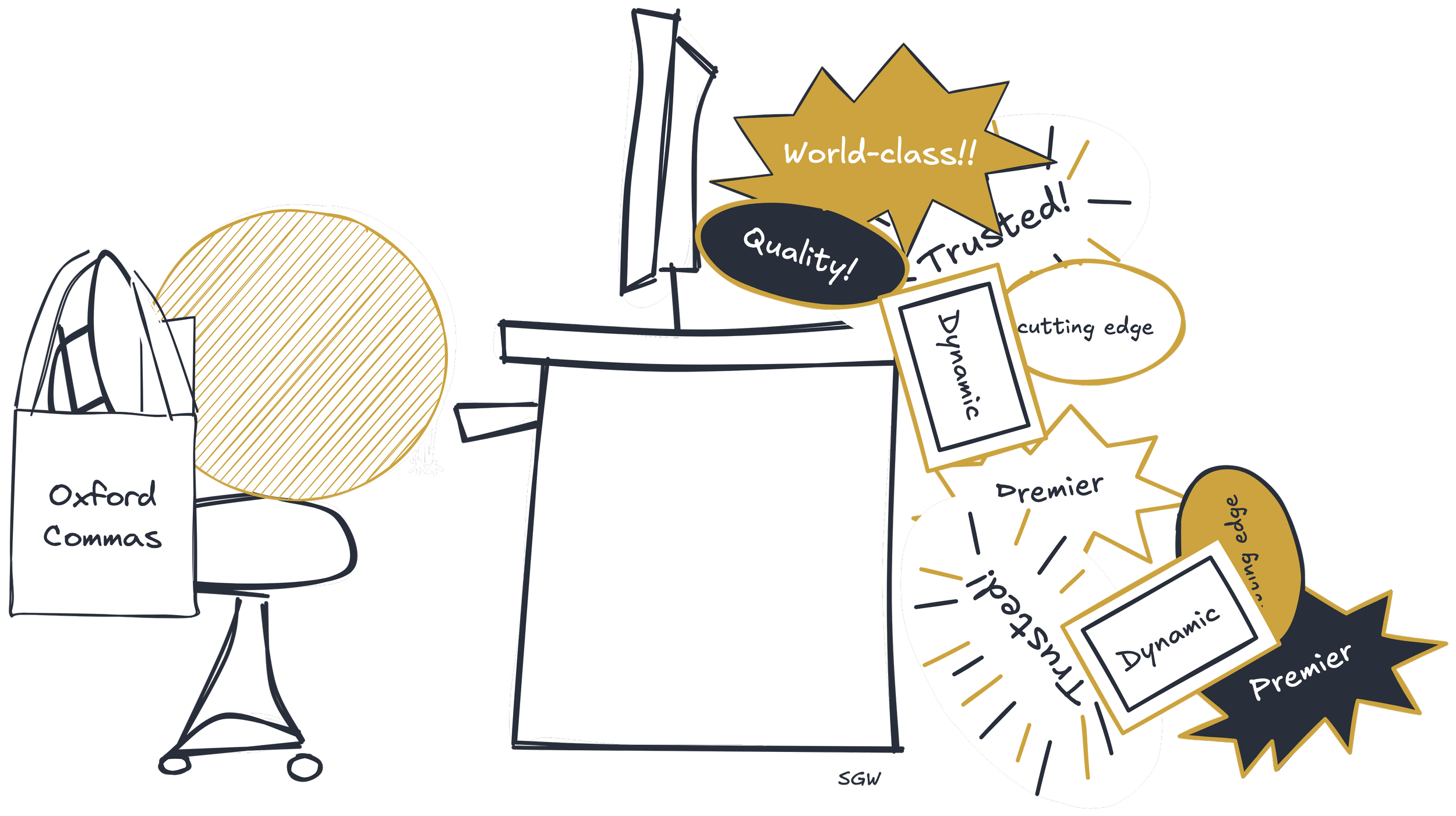
People who are incredibly good at what they do are frequently not great at talking about what they do. That quirk between “the work” and “the fluff” (how I imagine it’s discussed in some rooms) usually appears in one of two ways: 1. The business ignores it entirely for a bare bones website with a contact button or 2. They wing it with grandiose-but-bland adjectives. Honestly, a bias to the first option serves you better than "Quality, trusted, world-class solutions." Words that sound like something and mean nothing, because they're covering for the fact that there's no specific thing underneath. (If you have to tell me you're trusted, we have a problem, and it both is and isn't trust.)
And, listen, I have written "world-class" more times than I can defend (usually around 4:45 on a Friday). But when I read an About page or a newsletter or a blog post where the people who do the work can’t help but go in the weeds on what they do, I can feel that there’s real competence and care there. It’s a few sentences about how they set a fence post, a story about the mitering method they use, or a few concrete words on what it feels like to be at the office on a Tuesday.
Is there a possibility that that information turns into a way-too-long description of the construction site at dawn? Sure.
But the concrete detail is a stand-in for actually being good at the small, important thing. You can only describe the drainage plan in loving detail if you actually sweated the drainage plan, and sweating the drainage plan is exactly the kind of unsexy competence that makes a business hard to replace. That detail is a moat you can read.
Here’s a secret: We’ve been trying to rewrite the language on our home page, on and off, for over two years because we’ve got a nagging feeling that other firms are starting to use language like ours (it’s part of why we pivoted away from “boring businesses” a few years ago). We have an office full of excellent wordsmiths and contrarian thinkers. My whole job is writing. We know what we do, for whom, and how. And we know how it’s different from what other people are doing. So why the 2+ years?
Two things are going on, I think. The first is that our language actually does tell people who we are and what we do – in the odd specifics that make it real. It’s possible that we’re fighting something that shouldn’t be fought because of a bias towards action. The second is that it’s often hard, when you’re in the trenches, to see what your “best thing” is, or that it’s worth talking about. "Everybody in my field knows how to do that." Maybe. But everybody isn't doing it, and your customers have stuck around because you’re the one who does. The thing you're tempted to skip past (because it's just how you've always worked) is very often the most valuable sentence on the whole page.
The thing is that shifting the way you talk about what you do to the nitty-gritty of what your best thing is is a deeply hopeful habit. It’s not about doing more or doing better, but noticing what you’re already good at and telling people that. Rather than another adjective.

Sign up below to get Unqualified Opinions in your inbox.
The information, opinions, and views presented in this publication are provided solely for general informational and educational purposes. They are of a general nature, have not been tailored to the specific circumstances of any individual or entity, and do not constitute a comprehensive statement of the matters discussed. This material should not be interpreted or relied upon as investment, legal, tax, accounting, regulatory, or other professional advice, and nothing in this publication is intended to be or should be construed as such. You should obtain advice from your own professional advisors regarding the applicability of the information to your particular circumstances.
The views and analyses expressed are those of the author and do not necessarily represent or reflect the views, opinions, policies, or positions of Permanent Equity Management, LLC, its officers, directors, employees, affiliates, or portfolio companies, or of any person or entity with whom the author may be affiliated. Permanent Equity Management, LLC makes no representation or warranty, express or implied, as to the accuracy, completeness, timeliness, or suitability of the information contained herein and expressly disclaims any liability for errors or omissions.
This publication is not, and should not be construed as, an offer to sell, a solicitation of an offer to buy, or a recommendation of any security, financial instrument, or other product. It does not form the basis of any contract and does not create a fiduciary, advisory, or client relationship with Permanent Equity Management, LLC. Any examples or references to third-party content are for illustrative purposes only and do not constitute an endorsement. Permanent Equity Management, LLC is not responsible for the availability, accuracy, or content of third-party materials. Past performance is not indicative of future results. Any forward-looking statements are inherently uncertain and subject to change.
