
Diet Review Series: Paleo
From Director of Health Alex Maples
Eat like our ancestors because they were free from disease… right?
The Paleo diet originated in anthropology. Early researchers studying hunter-gatherer populations observed very low rates of the metabolic diseases common in modern societies: obesity, type 2 diabetes, and heart disease. This inspired thinkers like Walter Voegtlin, who published The Stone Age Diet in 1975. Voegtlin and others argued that humans evolved to eat only foods available during the Paleolithic era (roughly 3 million to 10,000 years ago), and that agriculture introduced grains, sugar, and other foods to which humans weren’t adapted. This “evolutionary mismatch,” they suggested, caused modern metabolic disease.
On vibes, the theory sounds great. History complicates it. Type 2 diabetes and atherosclerotic heart disease didn’t explode right after the agricultural revolution. In fact, they were rare until the late 1700s, when they appeared primarily as diseases of wealth. They still didn’t affect the general population in any significant way until the early 20th century, accelerating dramatically after World War II.
This timing suggests a murkier reality. Rather than “we ate foods we didn’t evolve to eat,” the explosion of metabolic disease aligns more closely with industrialization: less physical activity, far greater food availability, and the rise of highly processed, shelf-stable, energy-dense foods (many developed to feed soldiers overseas) making their way into the general population.
None of this means that a Paleo diet can’t be healthy or effective for weight loss. But it does undermine the claim that modern metabolic disease is primarily a post-agricultural mismatch.
That's enough history. Let’s dig in!
Paleo Defined
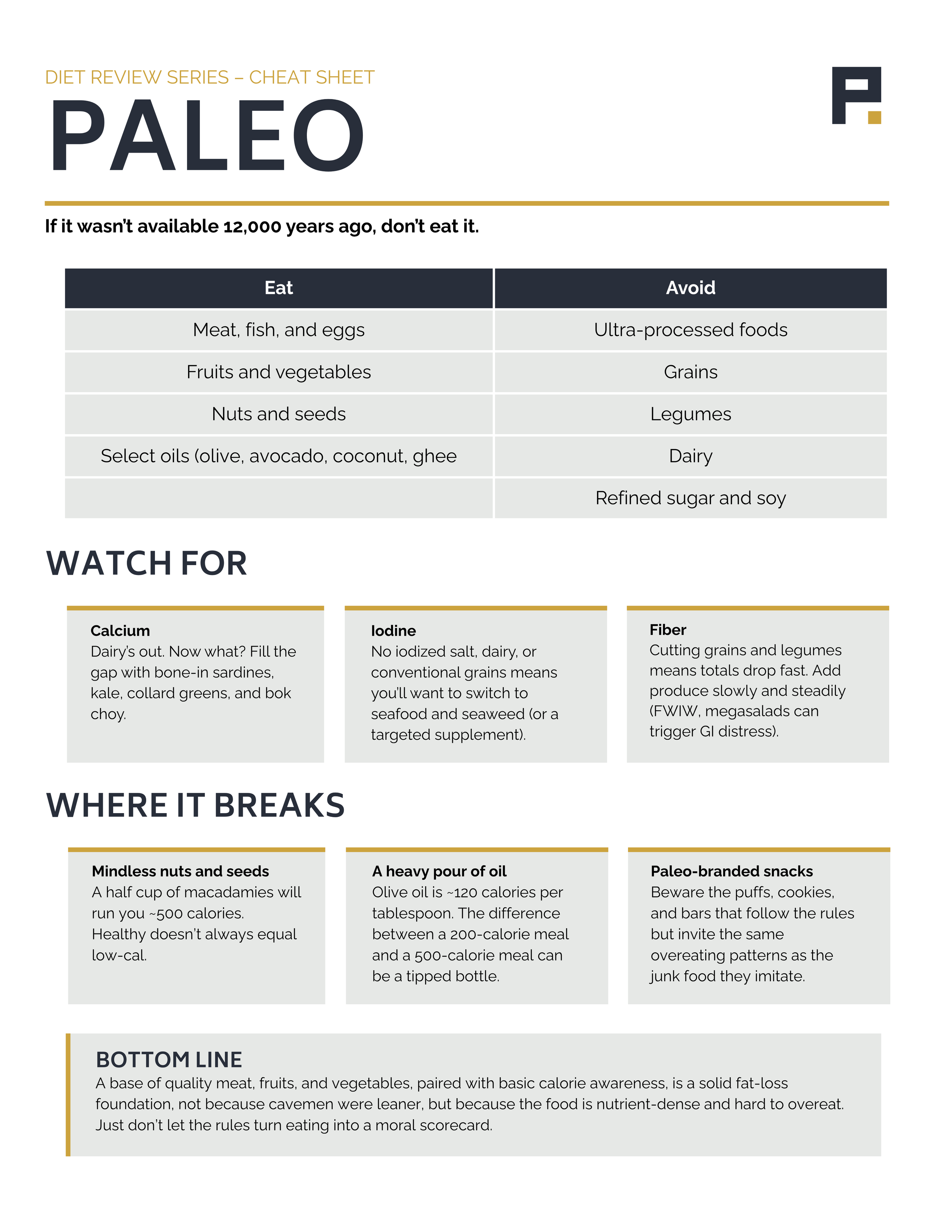
Core rule: If it wasn’t available 12,000 years ago, don’t eat it.
Well…with modern caveats. Many current Paleo plans include refined oils like coconut oil, olive oil, avocado oil, and ghee. Strict Paleo purists may disagree.
Included Foods
Meat, fish, and eggs
Fruits and vegetables
Nuts, seeds, and added fats (olive oil, avocado oil, coconut oil, ghee)
Excluded Foods
Ultra-processed foods
Grains
Legumes
Dairy
Refined sugar
Soy
How Paleo Reduces Calorie Intake
Constraint = fewer easy calories. Removing ultra-processed foods dramatically lowers overeating risk. Remember the Kevin Hall study where participants ate ~500 calories per day more on ultra-processed diets? Paleo largely eliminates that exposure. That’s, generally, a win.
That said, a note on “processed.” Not all ultra-processed foods are inherently bad. Convenience foods can be useful tools and help fill nutritional gaps. Whey protein powder, for example, is technically ultra-processed, but can be a highly practical and health-positive way to hit protein targets.
Restaurants become friction. Between seed oils (which may not actually be harmful), butter, sugar, soy, emulsifiers in sauces, dairy-based dressings, and grains hidden everywhere, eating out is a Paleo minefield. From a fat-loss and health perspective, this friction can help. From a convenience and enjoyment standpoint, it can be tough.
Potential Nutrient Gaps
Paleo is generally nutrient-dense: Meat, fruits, and vegetables provide a wide range of vitamins and minerals. Still, there are a few nutrients that require intentional planning.
Calcium
Removing dairy creates a significant calcium gap. That doesn’t mean calcium is unavailable on Paleo, but you have to seek it out.
Good Paleo-friendly sources include:
Sardines with bones
Dark leafy greens like kale, collard greens, and bok choy
Iodine
By removing iodized salt, dairy, and conventional grains, it removes common iodine sources.
Interestingly, iodine in grains largely comes from dough conditioners and dairy iodine comes from iodine in cattle feed and iodine-based disinfectants used in milking.
Without these, iodine intake can drop unless you eat seafood or seaweed regularly.
Fiber
This one surprises people.
Yes, fruits and vegetables contain fiber, but typically in smaller amounts per serving. Grains and legumes are among the most efficient fiber sources, and removing them can significantly reduce total intake.
While you can compensate with more produce, the volume required can lead to GI distress. Speaking from experience: Living on gigantic salads is a fast track to bloating and discomfort.
How We Break It (Common Failure Modes)
Nuts and Seeds
The easiest way to break Paleo is to overeat nuts and seeds. While healthy, nuts and seeds are very calorie dense and incredibly easy to mindlessly eat (as anyone who has sat down with a bag of shelled pistachios can attest to).
Calories per ½ cup:
Almonds: ~410–430 kcal
Cashews: ~430–450 kcal
Walnuts: ~370–390 kcal
Pecans: ~370–380 kcal
Pistachios: ~330–350 kcal
Macadamia nuts: ~500–520 kcal
Brazil nuts: ~470–490 kcal
Sunflower seeds (hulled): ~410–430 kcal
Pumpkin seeds (pepitas): ~360–380 kcal
Sesame seeds: ~410–430 kcal
Chia seeds: ~360–380 kcal
Flax seeds: ~300–320 kcal
Cooking Oils
Olive oil is one of the most health-positive foods on the planet. It also contains ~120 calories per tablespoon.
If you aren’t measuring, the difference between a 200-calorie meal and a 500-calorie meal can be as simple as tipping the bottle a little too far.
Fatty Meats
Fatty cuts like ribeye and pork butt aren’t inherently problematic, but ignoring calorie density while eating large portions at every meal can quickly stall fat loss.
Processed “Paleo” Snacks
Anytime a diet gains popularity, the market responds to fill the niche. Enter Paleo puffs, cookies, crackers, and bars. Essentially a lineup of processed snacks performing ingredient gymnastics to create a less tasty version of everyone’s favorite junk foods that still technically follow the rules of whatever diet is currently in fashion.
Paleo isn’t nearly as hot as it was 10 years ago (or was it 15? Damn I’m getting old), but these products are still very much alive. And, as always, processed foods designed to be palatable, even when branded as “healthy,” can be easy to overeat.
To their credit, Paleo-branded snacks do have a few things working in their favor. They’re generally more nutrient-dense than conventional junk food, often less hyper-palatable, and usually more expensive. All three of those factors can naturally limit intake for a lot of people.
Still, they’re snacks, and snacks that try to mimic indulgent foods tend to invite the same behavior patterns. Paleo rules don’t make you immune to overeating.
Sustainability Factor
If you’re comfortable cooking most of your own food, Paleo can be a plausible long-term approach. Modern access to a wide variety of fruits, vegetables, herbs, and spices keeps it more interesting and satisfying than the name might suggest.
The main challenge is social. Dining out narrows options quickly. As diet dogmas go, you could do worse than Paleo; just know where the friction lives.
The Final Verdict
Building the foundation of your diet around Paleo-approved foods, paired with basic calorie awareness, is a solid strategy. Not because cavemen were jacked or disease-free, but because a base of quality meat, fruits, and vegetables reliably delivers protein, micronutrients, and good satiety.
That said, there’s nothing inherently wrong with including whole grains, dairy, legumes, or even the occasional processed food, as long as overall calories are kept in check. One of the biggest pitfalls of diets built on a “good food vs. bad food” framework is that they moralize eating. For some, those rules fuel cycles of rigid “good” weeks, then “bad” rebounds and binges.
Food choices work best when they’re practical, flexible, and sustainable, not when they carry a moral scorecard.
New to the Diet Review Series? Start with Setting the Table — it lays out the fat-loss lens we run every diet through.