
Diet Review Series: Vegetarian
From Director of Health Alex Maples
I can smell the patchouli already.
Up next in the Diet Review series, we have the Vegetarian Diet.
Before we go further, let’s get specific. “Vegetarian” is an umbrella term covering several patterns. Broadly speaking, vegetarian diets center around fruits, vegetables, legumes, whole grains, nuts, and seeds, while excluding meat and animal products to varying degrees.
Where Vegetarianism Came From (And What It Wasn’t)
Vegetarianism did not originate as a health or weight-loss strategy. Its roots trace back to ancient India (roughly 1500-500 BCE) within spiritual traditions like Jainism, Hinduism, and, later, Buddhism. These practices are grounded in ahimsa – nonviolence toward living beings. Abstaining from meat became a moral and spiritual act.Vegetarianism didn’t acquire a health-oriented justification until the 1800s, largely through the Seventh-day Adventist movement. Still spiritual, but now with health longevity claims in the mix.
The China Study and the Modern Health Narrative
Enter The China Study, one of the most cited (and often misinterpreted) nutrition studies of all time.
A large epidemiological study examining dietary patterns, blood markers, and disease outcomes across rural Chinese counties, The China Study is frequently referenced in vegetarian circles. Regions with lower meat consumption tended to show lower rates of cardiovascular disease and more favorable lipid profiles.
Vegetarian proponents often point to this and conclude: Meat causes heart disease.
But context matters. The counties consuming more meat were generally more modernized. Think higher tobacco/alcohol use, less physical labor, and more access to meat. These were still relatively active, non-industrial populations, but the lifestyle differences mattered.
None of this “debunks” vegetarianism as a healthy option. It does, however, weaken the claim that meat intake itself was the primary driver of disease differences.
The author of The China Study later made broad claims that meat was inherently harmful, an interpretation that overreaches the evidence. Still, it undeniably cemented the “vegetarian equals healthier” narrative and helped propel vegetarianism into the modern wellness sphere. Add in growing concern about large-scale meat production, and vegetarianism is now both a moral and a health conversation.
Where I Stand
No moral arguments here. I personally choose to eat meat and think sourcing ethically is worth the effort when possible. That said, if vegetarianism is the path you want to take, what follows are the practical considerations needed to make it nutritionally sound, especially if fat loss is the goal.
Diets Under the Vegetarian Umbrella
Lacto-ovo vegetarian: Includes eggs and dairy, excludes all meat
Lacto vegetarian: Includes dairy, excludes eggs and meat
Ovo vegetarian: Includes eggs, excludes dairy and meat
Pescatarian: Includes fish, eggs, and dairy; excludes land-based meat
Vegan: Excludes all animal products, including eggs, dairy, honey, and animal-derived ingredients (vegetarianism’s militant cousin)
For this series, it makes the most sense to split vegetarian diets into three buckets:
Lacto-ovo variations
Pescatarian
Vegan
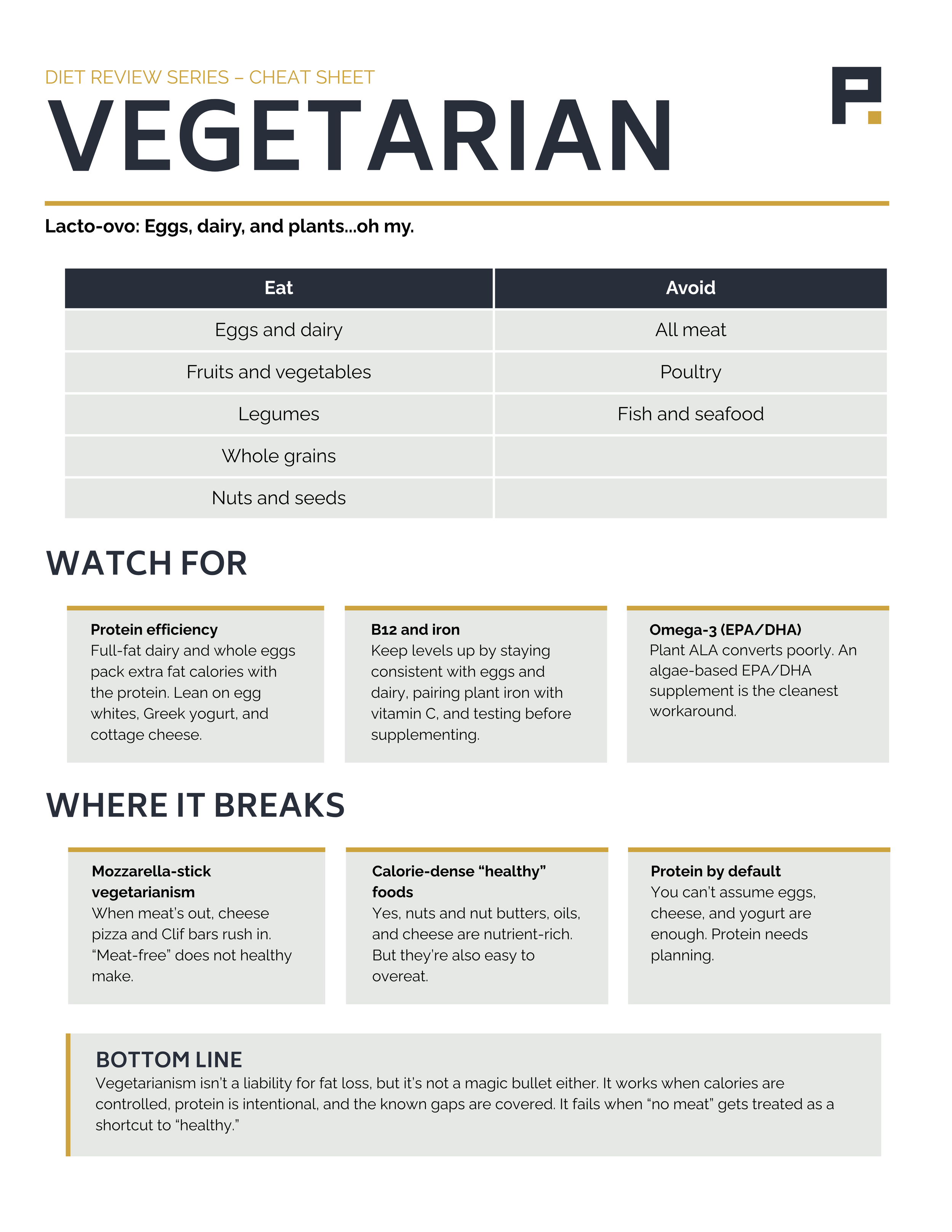
Here we’re talking about lacto-ovo variations, which center eggs, dairy products, fruits, vegetables, legumes, nuts, and seeds while excluding any form of meat.
How Vegetarianism Reduces Calorie Intake
There’s a common assumption that removing meat automatically reduces caloric intake. That can be true if “meat” means cheeseburgers, chicken tenders, and racks of ribs.
But meat can also be one of the leanest, most protein-dense foods available. Chicken breast, lean cuts of beef, pork tenderloin, and fish provide a lot of protein for relatively few calories.
So removing meat doesn’t automatically reduce calories.
Potential Nutrient Gaps
Protein (Amount and Quality)
Complete proteins contain all nine essential amino acids. Outside of meat, these are relatively limited, but eggs and dairy help a lot in lacto-ovo patterns.
The practical issue is calorie efficiency.
A whole egg has ~70 calories, ~7 g of fat, and ~7 g of protein. Fat provides 9 calories per gram, while protein provides 4. Eggs aren’t “bad,” but they’re more fat-dominant than protein-dominant. If most protein intake comes packaged with fat, calories can climb quickly.
Full-fat milk, cheese, and yogurt also provide high-quality protein and contain fats that can be nutritionally valuable, supporting satiety, hormone production, and absorption of fat-soluble vitamins. However, fat is still calorically dense, and those calories add up. When protein needs are high, relying primarily on full-fat dairy can make it harder to stay within an overall calorie target.
The good news: Modern options like egg whites, fat-free Greek yogurt, cottage cheese, and other low-fat dairy products dramatically improve protein-to-calorie ratios, making it far easier to hit protein targets while keeping total calories in check.
Vitamin B12
Vitamin B12 is found exclusively in animal foods.
Eggs and dairy contain some, but in much lower concentrations than meat. One egg provides roughly 20–25% of the RDA, while a 3 oz serving of beef provides 100–110%.
This doesn’t make deficiency inevitable, but it does require consistency and planning. Miss a few days of eggs or dairy, and intake drops fast.
Iron
Iron deserves special attention, particularly for women.
Heme iron (from meat) is highly bioavailable
Non-heme iron (from plants and eggs) is absorbed less efficiently
Even more important: Heme iron enhances absorption of non-heme iron. Remove meat, and you lose both the best iron source and the absorption boost.
Dairy complicates this further: It contains little iron, and calcium can inhibit iron absorption. If dairy is doing most of the protein work while iron intake is low, deficiency risk increases.
Because excess iron is also harmful, blanket supplementation isn’t ideal. Bloodwork and targeted supplementation are the smarter route.
Omega-3 fatty acids
Omega-3s are a common weak point across most diets.
There are three forms:
ALA (plant-based precursor)
EPA (cardiovascular support)
DHA (brain and nervous system structure)
ALA converts poorly to EPA and DHA. Since EPA and DHA are found primarily in fish, vegetarians often come up short.
An algae-based EPA/DHA supplement is the cleanest workaround.
How We Break It (Common Failure Modes)
I call this “mozzarella stick vegetarianism.”
Meat gets removed, but it’s replaced with cheese pizza, deep fried mozzarella sticks, Clif bars, and other ultra-processed junk that happens to be vegetarian. Avoiding meat becomes a proxy for “healthy,” even when calories are high and nutrient density is low.
Not eating meat does not prevent overeating. There’s no shortage of highly palatable, calorie-dense vegetarian foods (once again, I’m looking at you, peanut butter).
Sustainability Factor
Lacto-ovo vegetarianism is highly sustainable, especially today. Restaurants and food companies cater to it well, and convenience is rarely an issue.
From a fat loss perspective, it offers no inherent advantage over other diets. You could even argue it introduces a small disadvantage by excluding lean, protein-dense meats. But, that’s easily offset with intentional food choices.
As with most diets, emphasizing fruits, vegetables, legumes, and whole foods improves satiety and micronutrient intake, making a calorie deficit easier to maintain.
The Final Verdict
Vegetarianism doesn’t automatically make you lean or healthy.
Calories still matter. Protein still matters. Nutrient coverage still matters. Removing meat doesn’t inherently create a caloric deficit, nor does it guarantee better body composition. What the epidemiological data does consistently show is that vegetarians, on average, tend to be leaner and have more favorable cardiometabolic risk profiles than typical Western omnivores. However, more recent data has added important nuance. The advantages associated with vegetarian diets appear to be driven far more by overall diet quality and lifestyle behaviors than by meat avoidance itself. When confounding factors like physical activity, smoking, alcohol use, and socioeconomic status are better accounted for, the mortality advantage of vegetarian diets becomes less consistent, even though improvements in markers like blood lipids, blood pressure, and diabetes risk often remain.
In other words, vegetarian diets tend to work well when they are built around whole, minimally processed foods and supported by generally health-conscious behaviors, just like every other diet strategy.
From a fat loss perspective, vegetarianism is neither a magic bullet nor a liability. It’s a viable framework that can support leanness and long-term health, but only when calories are controlled, protein intake is intentional, and known nutritional gaps are addressed. Removing meat doesn’t do the work for you. Thoughtful planning does.
New to the Diet Review Series? Start with Setting the Table — it lays out the fat-loss lens we run every diet through.