Diet Review Series: Vegan
From Director of Health Alex Maples
Patchouli intensifies.
If vegetarianism is the cousin who shows up late, veganism is the one who brought a PowerPoint. It takes the “no meat” premise and extends it: no leather, no wool, no animal-derived ingredients anywhere in the basket.
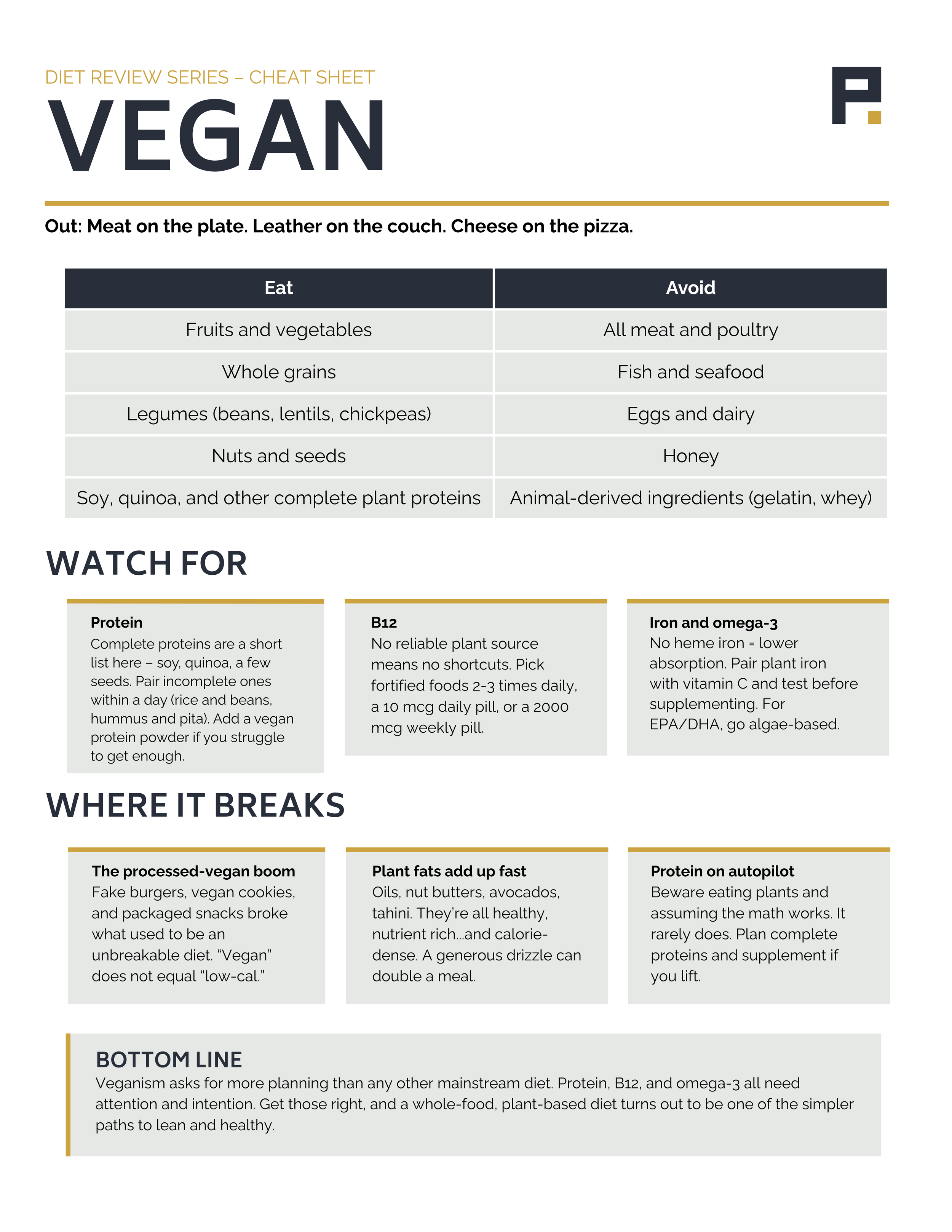
Veganism existed as a quiet subcategory of vegetarianism for thousands of years, grounded in the same spiritual traditions. The modern distinction started in 1944 when Donald Watson and others split from the UK Vegetarian Society, defining veganism as avoiding all forms of animal exploitation, not just meat on the plate, but leather on the couch and cheese on the pizza. For most of the next 70 years, that’s what veganism was: a small, ethically-motivated movement piggybacking on anti-war sentiment and environmentalism in the 60s and 70s.
The health framing showed up much later. Forks Over Knives (2011), amplified by Netflix and social media, recast veganism as a cure for cardiovascular disease.Beyond Meat and Impossible Burgers landed a few years later, turning a fringe lifestyle into a grocery-aisle option. Today, veganism lives as half ethics, half wellness (with the ethics often quietly in the back seat).
How Veganism Reduces Calorie Intake
If you’ve been following this series, the pattern should look familiar by now.
Veganism tends to reduce caloric intake largely by restricting food options. Theoretically, vegan diets are built almost entirely from whole grains, fruits, vegetables, legumes, nuts, and seeds.
The result? When done right, a substantial reduction in calorie intake, translating to lower obesity rates and, downstream, reduced rates of type 2 diabetes and cardiovascular disease.
Potential Nutrient Gaps
Veganism and vegetarianism share many nutritional challenges. But, with fewer fallback options, you need even more intentional planning to make sure you’re getting what your body needs.
Protein
Protein is the battle in the vegan world. Doable, but it takes strategy.
When we talk about protein requirements, we generally assume that most of it comes from “complete” proteins (i.e., ones that carry all nine essential amino acids in roughly the right ratios and are digestible enough to actually count).
What makes the cut? Soy checks all those boxes. So do quinoa, buckwheat, amaranth, and a few seeds (try chia and hemp). Frankly, it’s a pretty short list – and the reason vegans who are serious about protein talk a lot about soy.
Outside of complete proteins, the name of the game is pairing. (Note, it doesn’t have to be in the same meal, just the same day). Most traditional food cultures figured this out centuries ago:
Rice and beans
Lentils and wheat
Hummus and pita
Peanut butter and whole-grain bread
As an amino acid, leucine deserves special mention. It’s relatively scarce in vegan diets, but plays a critical role in muscle protein synthesis. For anyone trying to build or preserve muscle, a vegan protein powder (think soy isolate, or pea and rice blends) becomes less optional.
Vegan diets frequently mean higher total protein intake than omnivorous diets to compensate for lower digestibility and amino acid density. The upside is that these protein sources make you feel fuller for longer, meaning you’re less likely to overeat.
Vitamin B12
B12 is essential for DNA synthesis, red blood cell formation, and neurological function. But, it comes from bacteria. That means animal products or fortification – plants don’t provide it.
Supplementation is non-negotiable. Three working options:
Fortified foods (plant milks, nutritional yeast, fortified cereals) two to three times per day, targeting ~3mcg total
A daily supplement of >10 mcg
A weekly supplement of 2,000 mcg
Any of these work. This is a solved problem; you just have to be sure it’s actually solved for you.
Iron
Same story as the vegetarian diet. No heme iron at all, which means lower absorption and no absorption-boosting effect on the plant iron that is there.And, it’s a bigger issue for women than men.
But don’t supplement blindly. Consider regular bloodwork to understand what you actually need. Too much iron is just as problematic as too little.
Omega-3 fatty acids (EPA & DHA)
Plant foods provide ALA, which the body does convert into EPA and DHA – but inefficiently. As with vegetarian diets, an algae-based omega-3 supplement helps close the gap.
How We Break It (Common Failure Modes)
Twenty years ago, veganism was nearly unbreakable from a calorie-control standpoint. Processed foods were scarce, no one was making vegan snacks, and good luck finding a vegan restaurant outside of California. You practically had to chug olive oil and soda to gain weight.
But now.
Vegan fast food. Vegan junk food. Entire cookbooks are dedicated to hyper-palatable, calorie-dense vegan recipes. This is great for accessibility and sustainability. Less great for fat loss.
That said, sticking to vegan staples like tofu, rice, beans, fruits, and vegetables still generally translates to fat loss. The biggest challenge then becomes muscle maintenance, not fat gain. Again, the solution is strategy – sufficient protein, supplementation, and a solid resistance training program make the problem solvable.
Things fall apart (note the pattern in all of these diets) when ultra-processed foods dominate intake. As Kevin Hall has shown repeatedly, processed foods drive higher calorie intake. Period.
Sustainability Factor
Veganism used to require commitment. Now it doesn’t, and that cuts both ways. Veganism has never been more sustainable socially and logistically, but processed food strikes again.
The Final Verdict
If you’re going to make veganism work, you’ve got to be intentional. Protein intake must be planned. Vitamin B12 supplementation is mandatory. Omega-3s require attention. None of these are deal-breakers, but they do require forethought.
At the same time, veganism has never been easier. Gourmet vegan chefs exist. High-quality supplements are readily available. There are even vegan bodybuilders. Sure, many are on steroids, but that’s beside the point.
I like to poke fun at vegans because they’re an easy target. But the reality is that veganism can be a very healthy way to live. On average, vegans are significantly leaner and healthier than the typical omnivorous American, and building and maintaining muscle on a vegan diet is absolutely possible.
Turns out that eating a largely whole-food, plant-based diet tends to make people pretty lean and healthy. Who would’ve guessed?
New to the Diet Review Series? Start with Setting the Table — it lays out the fat-loss lens we run every diet through.