
Diet Review Series: IIFYM (If It Fits Your Macros)
From Director of Health Alex Maples
When lawlessness meets hyper-rigidity, you get a system that feels like freedom… until it doesn’t.
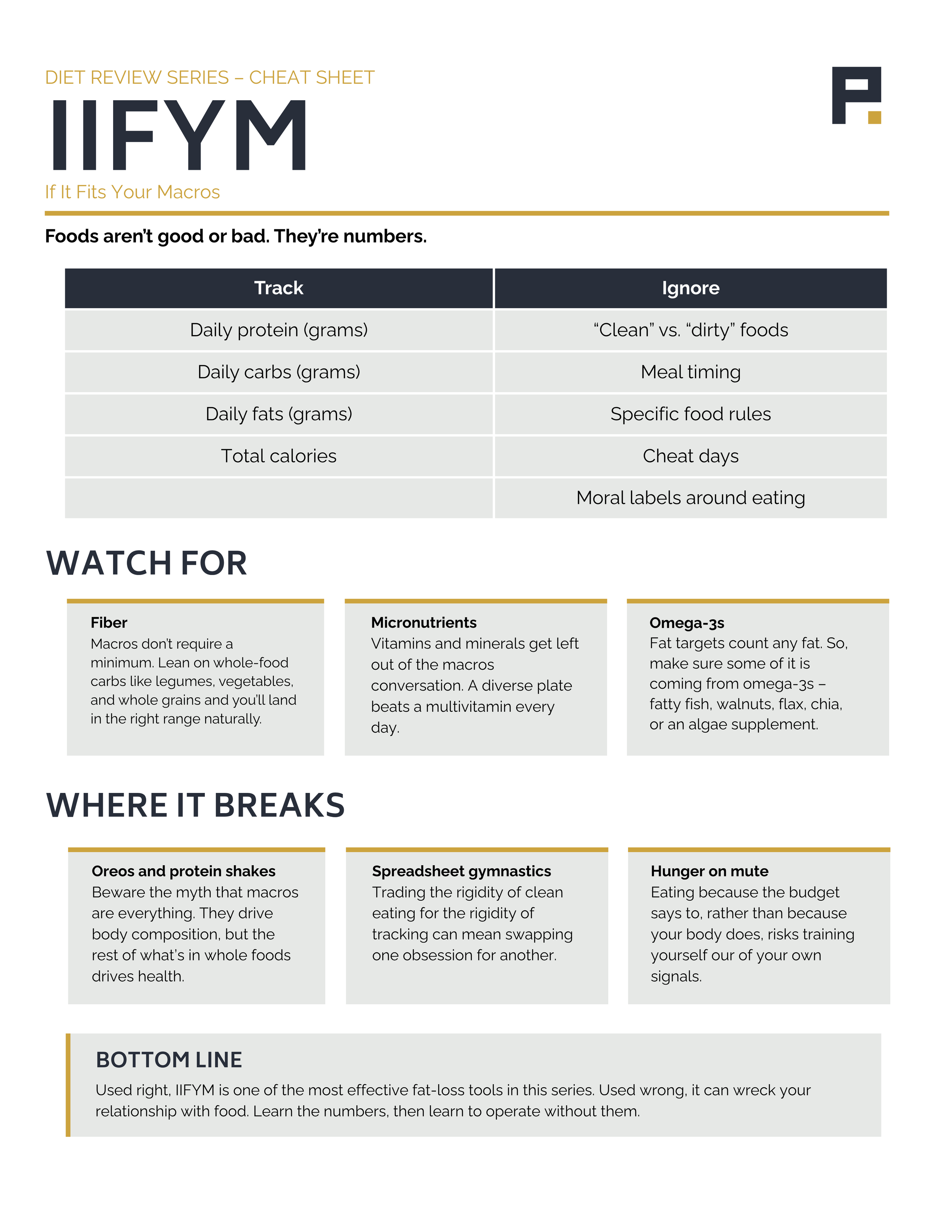
Born in the dark corners of late-90s bodybuilding forums, buried between grainy progress photos and endless debates about meal timing, IIFYM (if it fits your macros) stripped dieting down to its barest components. Macros, short for macronutrients, are the three primary components of food: protein, carbohydrates, and fats. Together, they make up the calories we eat. IIFYM takes this to its logical extreme: if your daily totals for protein, carbs, fats, and calories are on target, everything else is secondary.
Before IIFYM, the dominant belief was simple: to get lean, you had to eat “clean.”
In practice, this meant a narrow rotation of chicken, rice, and broccoli, along with a rigid moral hierarchy where foods were either “good” or “bad.”
The problem with clean eating wasn’t just boredom (although there was that). It was pressure. When every bite carries a moral label, slipping once often turns into abandoning the system.
IIFYM was a direct rebellion against the rigidity. It removed the moral labels and replaced them with math. Foods weren’t good or bad. They were numbers – information.
That shift was liberating. Instead of white-knuckling through weeks of restriction followed by explosive “cheat days,” people could incorporate foods they actually enjoyed on a regular basis and break free from the classic restrict-binge cycle that defined traditional dieting.
The catch is the machinery behind the freedom: food scales, tracking apps, spreadsheets, and the constant negotiation of numbers. Every bite becomes a transaction. Every meal is a budget decision.
Used right, IIFYM is a highly effective fat loss tool. Used wrong, it can break your relationship with food.
How IIFYM Reduces Calorie Intake
This is simple. IIFYM restricts calories by… restricting calories.
Your macro targets create a built-in calorie ceiling. Stay within the numbers and you stay within your energy budget. Overshoot, and you don’t.
No food rules required.
Potential Nutrient Gaps
All of them and none of them at the same time.
Since there are no recommended foods, you could get all of your necessary dietary components in a day or, outside of protein, be eating the most deficient diet imaginable. There are no recommendations for fiber intake, vitamins, minerals, or omega-3s, all of which are important parts of a healthy diet.
The smart play is to eat a wide array of nutritious foods while staying mindful of your numbers. In other words, stick with the intentions of IIFYM.
How We Break It (Common Failure Modes)
This part is a little more nuanced. The IIFYM premise works as far as it goes. Calories, macro distribution, and lifting absolutely drive body composition. Unsurprising, since the diet was built by bodybuilders.
But there’s a real difference between hitting those numbers eating meats, fruits, and vegetables and slamming Pop-Tarts and protein shakes. While calories and macros largely dictate body composition, the rest of what’s in your food shapes overall health, performance, and satiety. Fiber, micronutrients, and fats like omega-3s serve vital functions for overall health. Living on packaged nonsense and a multivitamin doesn’t quite serve the same function as eating whole foods.
IIFYM was meant to loosen the laces on what counted as okay to eat, as long as you still hit your goals. But, as the internet likes to do, recipes for outrageous concoctions and videos bragging about how many Oreos you could eat and still get shredded took over the IIFYM conversation.
What started as flexibility turned into spectacle. This is why we can’t have nice things.
IIFYM also breaks because it takes something genuinely helpful – macro targets – and turns it into the only thing. Exchanging rigid clean eating for spreadsheet gymnastics is just swapping one obsession for another.
And that obsession has unintended consequences. A big one? Losing the ability to tap into hunger cues. Hunger is not constant; some days you’ll be hungrier than others. If your sole focus is hitting your budget no matter how your body feels, you’re going to lose the natural ebb and flow of appetite.
If you get to the end of the day and feel satisfied but the budget says you’re supposed to eat 40 more carbs and you do, you are no longer training yourself to listen to your body. Most people don’t want to weigh food and track calories forever. While gaining awareness of the calorie content of various foods and how it feels to eat different amounts is good, training yourself out of listening to hunger cues might bite you in the ass in the long run.
Sustainability Factor
Like the hook implies, IIFYM is both incredibly flexible and super rigid at the same time.
From a food variety perspective, there are no rules, so boredom is a non-issue. At the same time, food quantity is strictly controlled (you weigh and log everything that passes through your lips). This doesn’t eliminate spontaneity, but it does turn it into a budgeting exercise. If you want something on the fly, you can have it. You just have to adjust for it later.
Where this becomes more difficult is in environments you don’t control. Restaurants, social events, and travel introduce a level of uncertainty where you don’t know the true composition of what you’re eating. You can estimate, but it’s no longer precise. For someone trying to strictly adhere to targets, that can create friction.
Sure, the flexibility makes it easier to navigate day-to-day life compared to more rigid diets, but it still requires a level of attention and planning that not everyone wants to maintain long term. It also has the potential to stir up disordered behavior around food.
IIFYM was never intended to be something you do forever, but rather a tool to gain awareness and reach a specific goal. From a sustainability perspective, it’s a powerful tool that should be used judiciously, but not indefinitely.
The Final Verdict
If you want to ensure success in weight loss, IIFYM is hard to beat. If you want to build a healthy relationship with food and hunger signaling, it can be either helpful or disastrous.
A healthy way to approach IIFYM is to eat a diet consisting of a variety of largely unprocessed foods like meats, vegetables, fruits, grains, legumes, and dairy, while also being mindful of the amounts you are eating. (This probably sounds familiar, if you’ve been following along.)
Use the tracking period as a calibration tool. Learn what a 500-calorie meal looks like on a plate. Learn how full 30 grams of protein actually leaves you. Then put the scale down.
Learn the numbers, then learn to operate without them.
New to the Diet Review Series? Start with Setting the Table — it lays out the fat-loss lens we run every diet through.